Find Someone on Dating Sites by Phone Number
Learn how to find someone on dating sites by phone number, which free checks confirm an account, and why a clean result doesn't necessarily mean anything.
Guides
Luke Belfield
Sep 16, 2026 • 6 min read

Your phone rings and the screen says: Unknown Number.
That label and "No Caller ID" are not the same thing, and the difference tells you more than you might expect.
Unknown Number means your carrier received a call it couldn't identify, such as a technical gap, a routing incompatibility, or a network that doesn't speak the same caller ID language as yours. No Caller ID means someone made a deliberate choice not to be identified. One is a glitch. The other is a decision. Both land on your screen looking identical. Both leave you asking the same question: who called me?
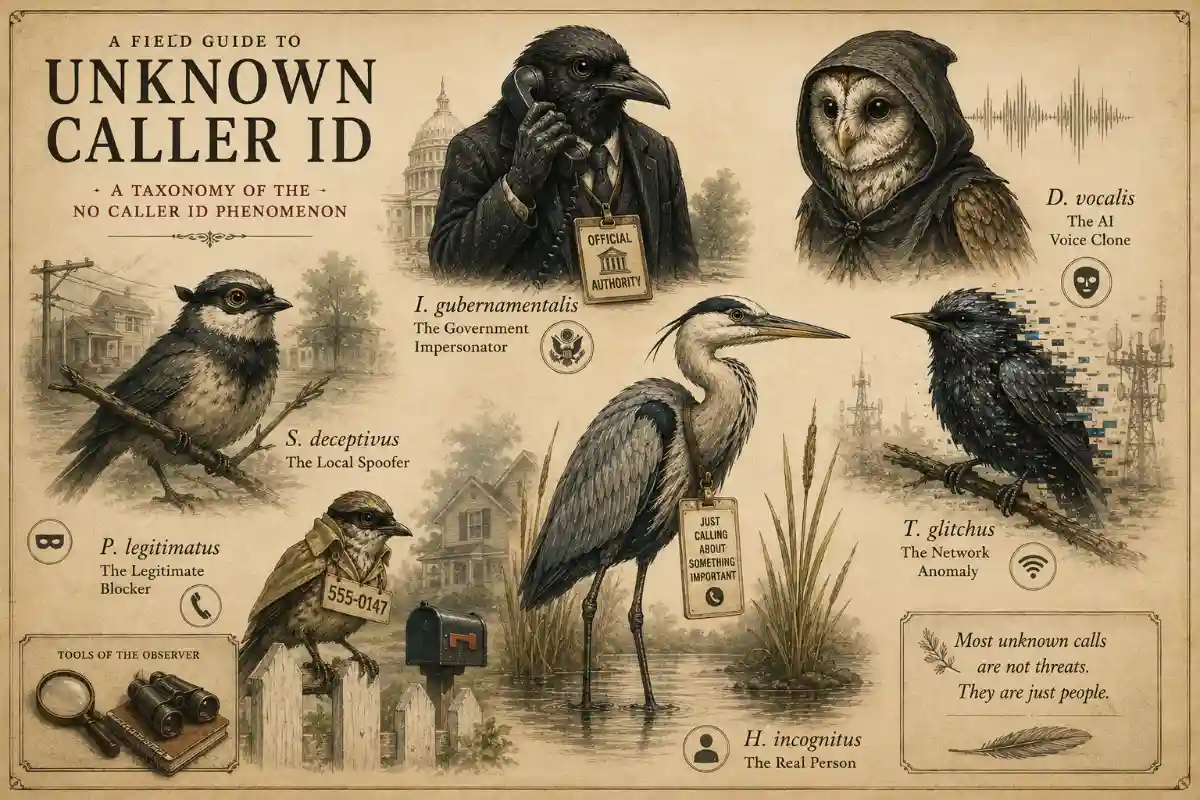
This is a field guide. It classifies unknown callers the way a naturalist classifies birds — by habitat, behavior, and threat profile, because such calls are almost always one of seven known species, and most of them are harmless. Occasionally, however, they cost people a significant amount of money.
The naturalist who encounters an unknown number and assumes it's a scammer makes the same error as the naturalist who assumes every unfamiliar bird is a sparrow. It’s possible – common, even – but it’s not always correct, and the cost of misidentification can be very high. After all, the FTC reported $12.5 billion in consumer fraud losses in 2024, and phone calls remain the second most common attack vector, behind only email.
What follows covers all seven species, each with its own behavioral signature, motivation, and risk level. Some will cost you money. Some are trying to help you. Most are just people. Knowing which is which is the difference between missing a call from your doctor and wiring $7,200 to someone pretending to be your grandchild.
Before cataloguing individual species, the naturalist must understand a foundational distinction that governs the entire order.
Unknown and No Caller ID are not the same thing.
The two labels describe different situations, produced by different mechanisms, and imply different things about the creature on the other end of the line.
Unknown Caller or Unknown Number means your carrier received a call but could not identify where it came from. The information simply isn't there — a technical gap, a network incompatibility, an international routing system that doesn't speak the same language as yours. The caller may not even know they're coming through as Unknown.
No Caller ID means someone made a choice. They dialled *67 before your number, or they called from a system configured to suppress outgoing identification. The information exists. It was withheld. This is an act of will.
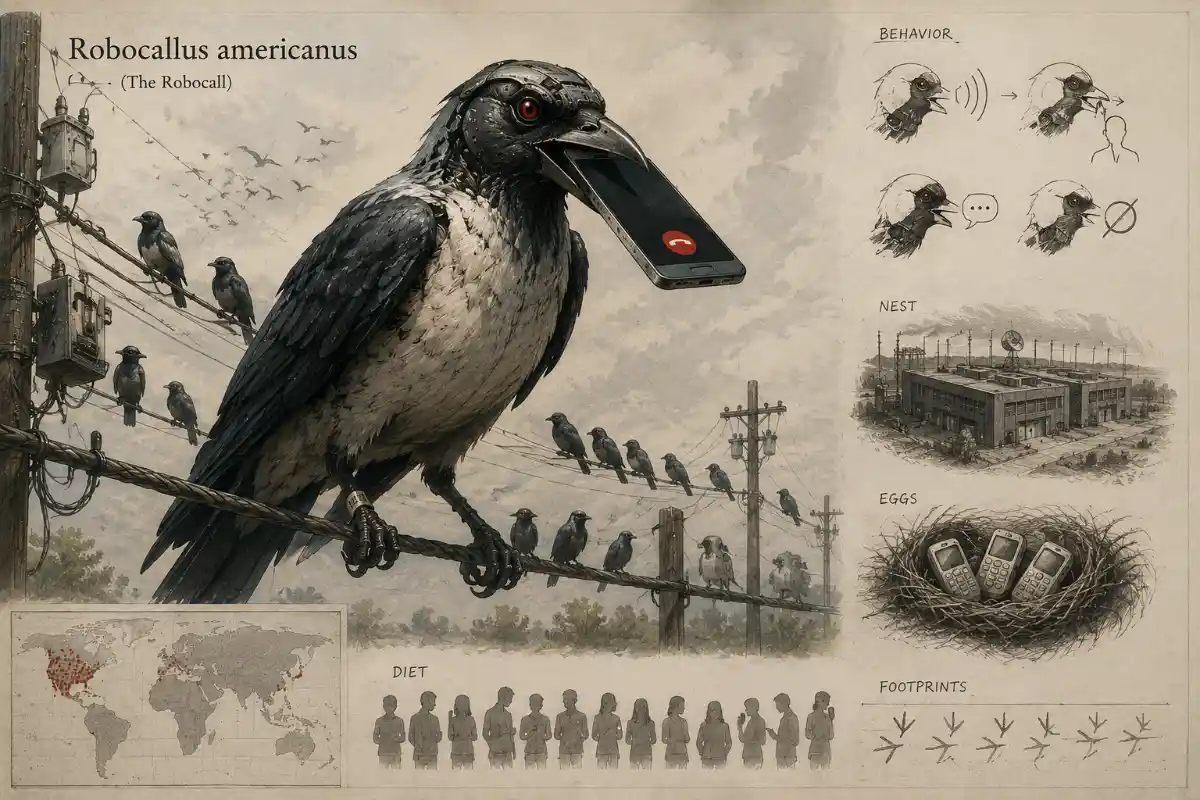
Habitat: Operates at industrial scale from carrier networks, data centers, and, increasingly, smaller regional VoIP providers specifically chosen because they have not yet fully implemented STIR/SHAKEN authentication requirements. Found in all 50 states. Heaviest concentrations reported in Oklahoma, Indiana, and Ohio. Global populations are also rapidly growing.
Behavioral notes: The Robocall (R. americanus) is distinguished by volume over precision. It does not target. It saturates. In the first half of 2024 alone, Hiya's detection systems flagged nearly 20 billion calls as suspected spam – more than 107 million per day. The Robocall does not call you because it knows anything about you. It calls you because your number exists and calling is cheap.
The call will be one of several subspecies. For example:
Threat level: Low-to-moderate. Financial damage requires the specimen to either transfer to a human operator or prompt you to call back a number. R. americanus cannot harm you if you do not engage.
Distinguishing field marks: No voicemail, or a generic recorded voicemail. Calls at scale — the same number may appear in community reporting databases with hundreds of recent reports. STIR/SHAKEN attestation absent or failed.
What your carrier is doing about it: Quite a lot, actually, and it still isn't enough. In 2022, 74% of calls from Tier-1 carriers were authenticated using STIR/SHAKEN, pushing less than 10% of unwanted robocalls through the major networks. The robocallers moved downstream, to smaller networks with weaker compliance. As of 2025, only 44% of 9,242 registered carriers had fully installed the mandated STIR/SHAKEN software, down from 47% the year before.
To understand how your carrier flags and labels these calls before they reach you, see our guide to how spam risk labels work and what to do when you see one.
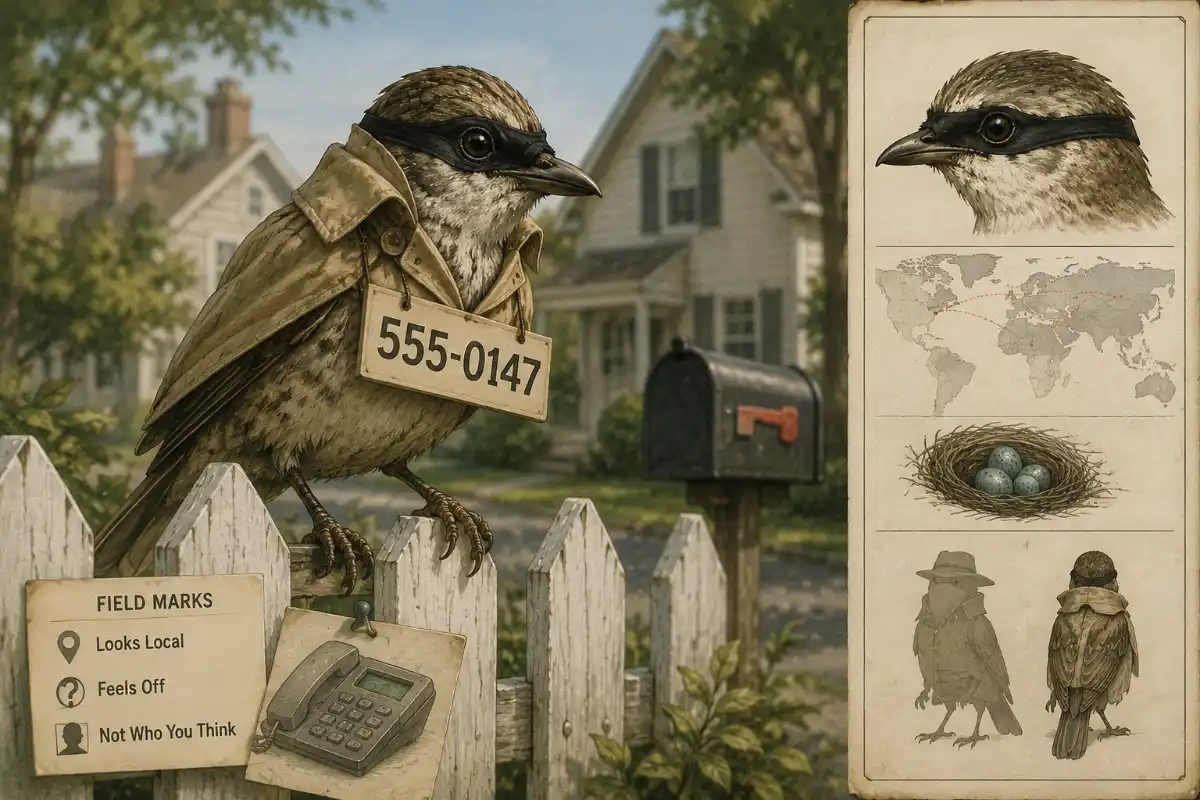
Habitat: Operates globally, predominantly from overseas call centers, but presents locally. The defining characteristic of S. localis is that the number on your screen looks familiar. Same area code. Sometimes the same first six digits as your own number. That’s no coincidence, rather the entire strategy.
Behavioral notes: The Neighbor Spoof (Spoofus localis) – sometimes known as Caller ID spoofing – is, as a technology, uncomplicated. A caller chooses a number to display, plugs it into a VoIP system, and it shows up on your screen. The friction is almost nothing. However, the effect is substantial, because people answer local numbers at significantly higher rates than unknown or out-of-state calls.
The number that appears on your screen almost certainly belongs to someone innocent. A pediatric dentist's office. A woman who has been getting angry callbacks all week and genuinely does not know why. The FCC's STIR/SHAKEN framework was designed to address this, requiring carriers to digitally sign calls, verifying that the number displayed is the number that actually made the call. Most spoofed calls fail this authentication.
Threat level: Moderate-to-high. S. localis is the delivery mechanism for most active phone scams. The local presentation is the hook that gets the call answered.
Distinguishing field marks: Appears local but feels off. Caller is insistent and creates urgency. If you call back, the number belongs to someone who has no idea what you're talking about.
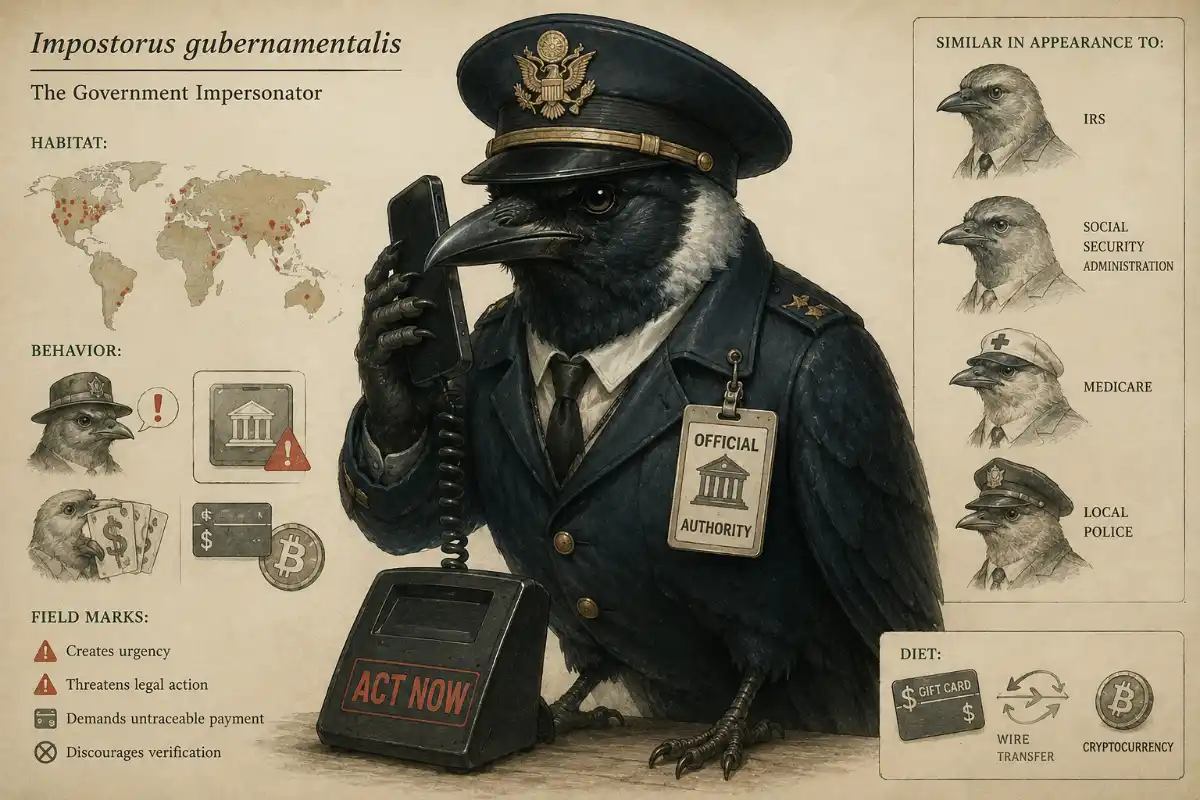
Habitat: Targets individuals broadly but concentrates on demographics statistically less likely to hang up. These include adults over 60, recent immigrants unfamiliar with how US government agencies actually communicate, and anyone experiencing financial stress. Operates year-round with seasonal spikes around tax season.
Behavioral notes: The Government Imposter (I. gubernamentalis) is the most financially destructive species in the order. It presents as a known, trusted authority – the IRS, the Social Security Administration, Medicare, Customs and Border Protection, a local police department – and uses that authority to manufacture compliance. The threat is immediate, and the window to act is narrow. The payment method requested is untraceable.
The key behavioral tell is the payment instruction. No government agency will ever ask you to resolve a legal matter with a gift card, wire transfer, or cryptocurrency payment. This is not a procedural quirk. It is definitional. A caller asking for a gift card is not from the IRS. The IRS does not have a gift card department.
Threat level: High. Highest among populations least likely to have encountered this species before. For a current overview of the scam types federal agencies are actively warning about, see our breakdown of phone scams the FBI and FTC are flagging right now.
Distinguishing field marks: Creates urgency, threatens legal consequence, demands immediate and untraceable payment, discourages you from hanging up to verify. Real governmental authorities mail letters. They do not call you out of nowhere and request same-day resolution via Google Play credits.
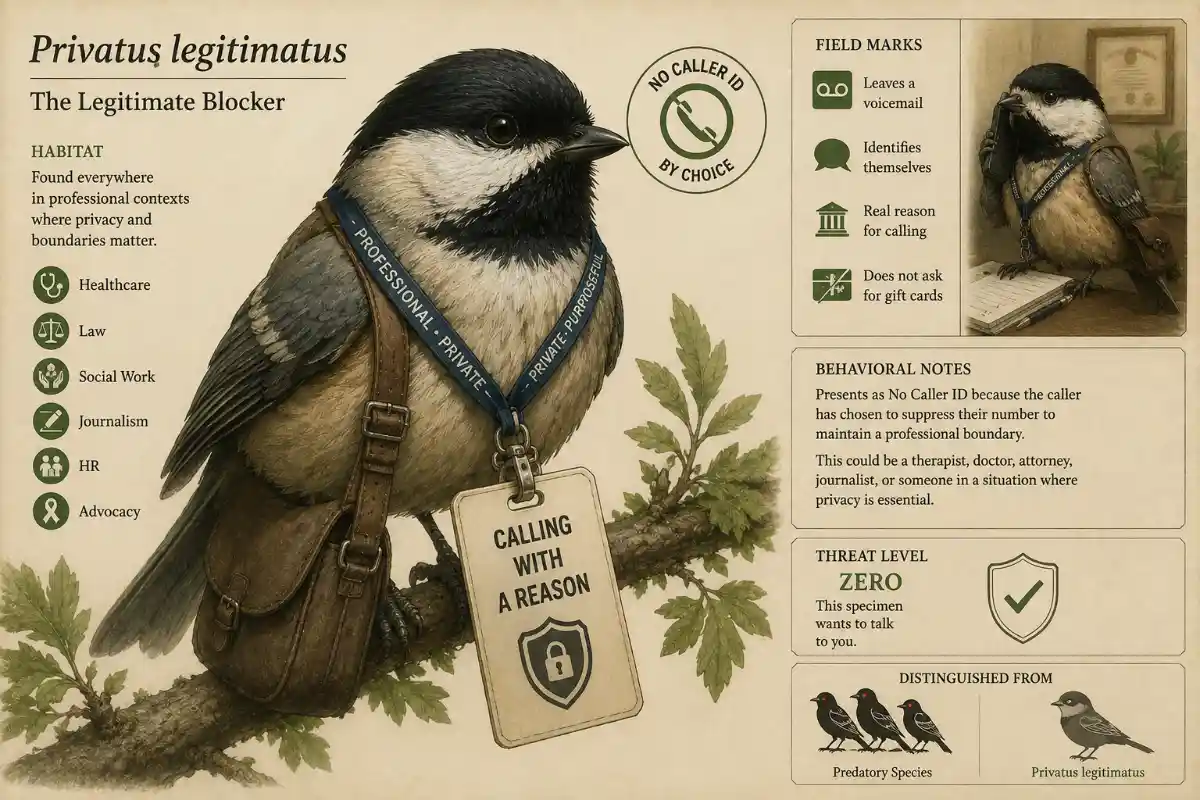
Habitat: Found everywhere. Healthcare, law, social work, journalism, domestic violence advocacy, HR departments. Any professional context where the individual making the call has a legitimate reason not to share their personal number with the recipient.
Behavioral notes: This species is responsible for a meaningful percentage of No Caller ID calls, and is frequently misidentified as a threat by recipients with no framework for distinguishing it from the predatory species.
The Legitimate Blocker (P. legitimatus) presents as No Caller ID because the caller has chosen to suppress their number – usually *67, or a system-level setting on a work phone – not because they are hiding from accountability, but because they are maintaining a professional boundary. This could be a therapist calling a client, a doctor returning a call from their personal line after hours, an attorney, a journalist, or someone leaving a domestic situation who cannot have an unknown party call them back.
Threat level: Zero. This specimen wants to talk to you.
Distinguishing field marks: Leaves a voicemail. Identifies themselves. Has a specific reason for calling that relates to a real interaction you've had with a real institution. Does not ask for gift cards.
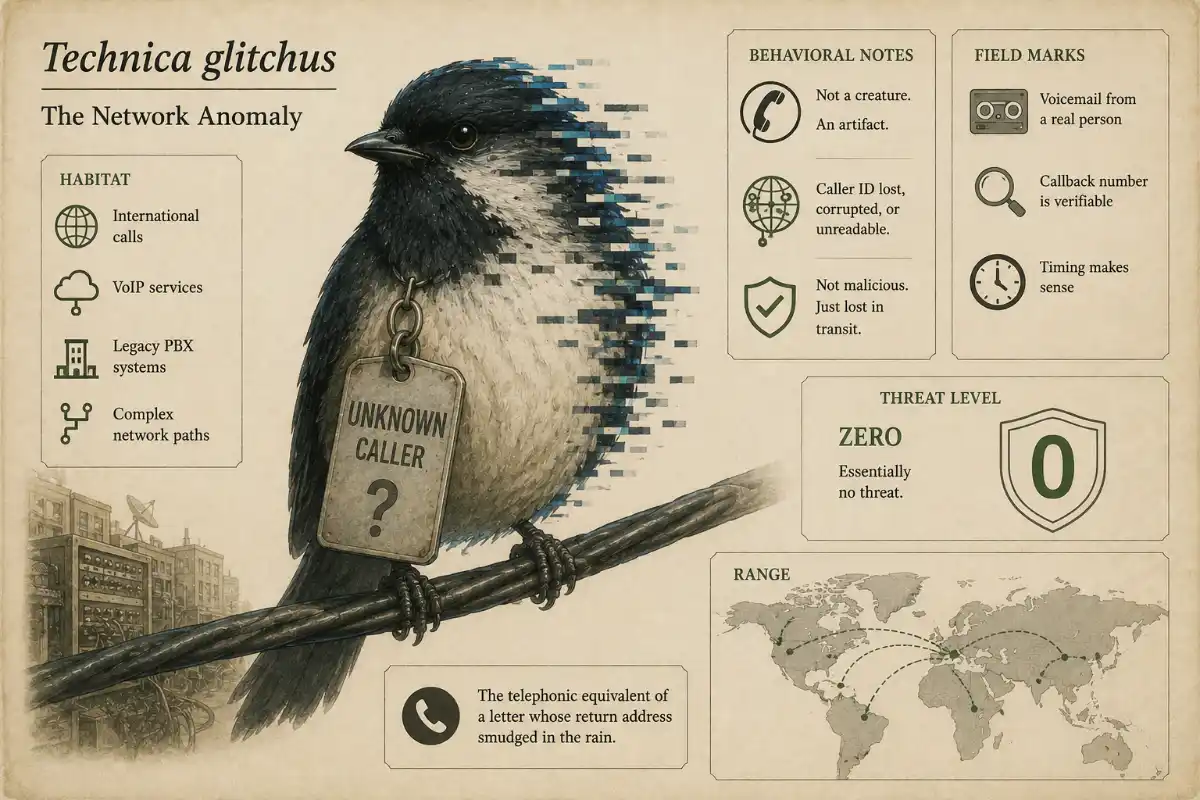
Habitat: International calls. VoIP services using non-standard configurations. Legacy PBX systems in older office buildings. Any call that has travelled far enough, through enough different networks, that the caller ID information was either dropped, corrupted, or never transmitted in a format your carrier can read.
Behavioral notes: The Network Anomaly (T. glitchus) is the least dramatic entry in this field guide and among the most misunderstood. It is not a creature at all. It is an artifact, the telephonic equivalent of a letter whose return address smudged in the rain.
The call coming in as Unknown is not the caller's choice and not a sign of malicious intent. The STIR/SHAKEN framework applies to US carriers operating IP networks. It does not govern a call initiated from a switching system in another country that simply doesn't pass caller ID in a format your phone can display.
Threat level: Essentially zero, though the presentation is indistinguishable from more concerning species until further investigation.
Distinguishing field marks: Often leaves a voicemail with a real person identifying themselves. Callback number, if given, is verifiable. Timing makes sense; a call from overseas at a reasonable hour, relating to something you have legitimate reason to expect.
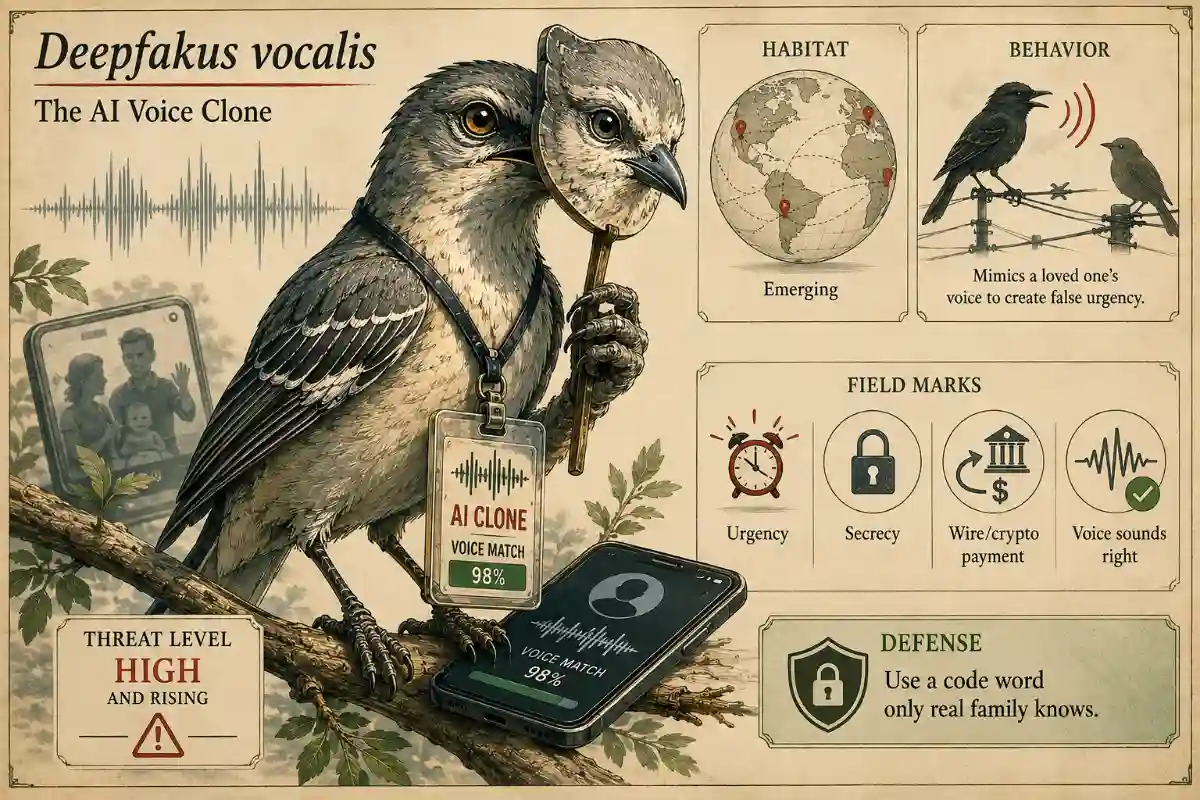
Habitat: Emerging. Currently concentrated in high-value scam operations targeting older adults and anyone with a family member whose voice is findable online through social media videos, public recordings, news appearances, or anything a model can train on. Distribution expanding rapidly.
Behavioral notes: This is the newest and most unnerving entry in the catalog. The AI Voice Clone (D. vocalis) does not merely impersonate an authority, rather a person you love, in their voice, with their cadence, under circumstances engineered to prevent you from thinking clearly enough to question it.
The scenario is known as the "grandparent scam" in its earliest form: a call from a grandchild claiming to be in trouble, needing money wired immediately, please don't call mom and dad. What AI voice cloning has done is removed the primary defence: the fact that the voice didn't quite sound right. For example, a Hiya survey of 2,000 US consumers found that in 2024, one in three Americans received at least one deepfake scam call, with 34% of those targeted losing an average of $7,200.
The counter-strategy is simple and should be agreed upon in advance by families: a code word. A specific phrase known only to the people involved. A fake grandchild in a fake crisis does not know your family's safe word.
Threat level: High and rising. The technology is improving faster than consumer awareness.
Distinguishing field marks: Urgency, secrecy, a request not to tell other family members, wire transfer or cryptocurrency payment. The voice sounds right. The rest of it doesn't.
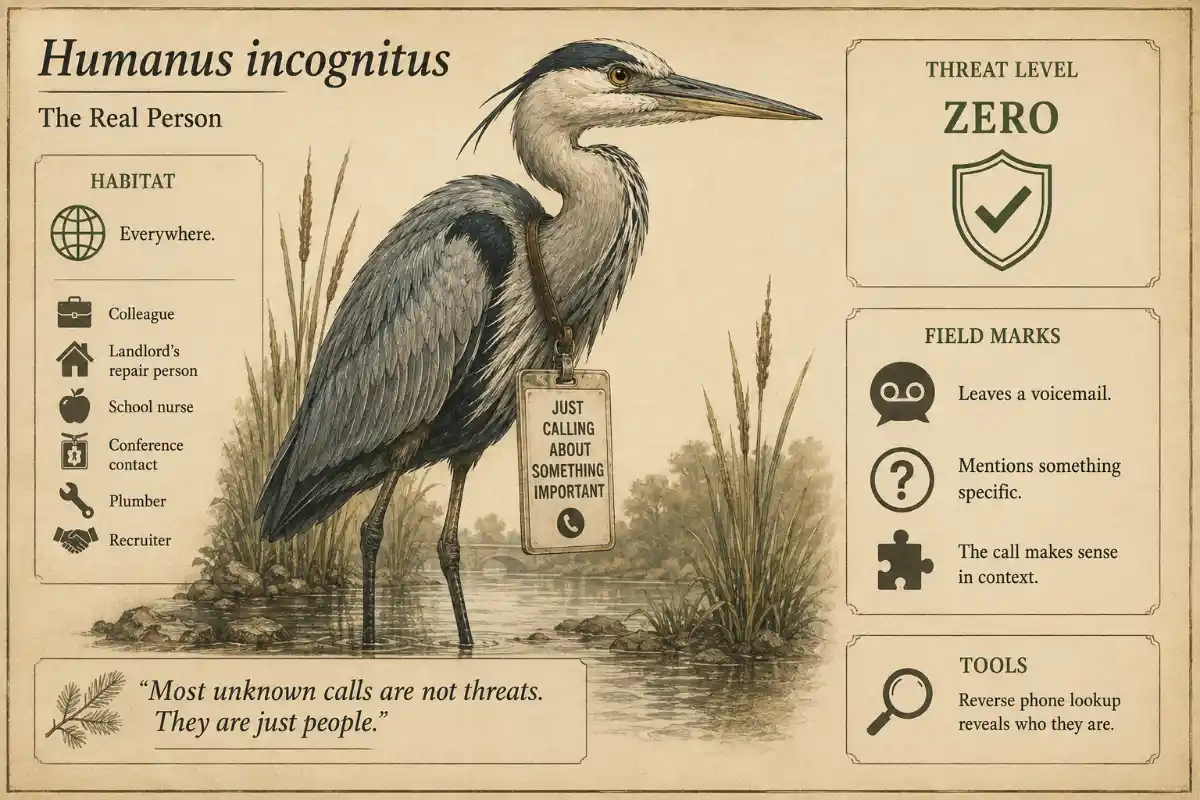
Habitat: Everywhere. The colleague whose number you never saved. The landlord's repair person. The school nurse. The contact from the conference two years ago. The recruiter. The plumber.
Behavioral notes: The Real Person (H. incognitus) is the hardest entry to write because it contains a truth that resists the clean architecture of a taxonomy: most unknown calls are not threats. They are just people. The phone system has a lot of people on it. Many of them do not appear in your contacts.
The problem is that H. incognitus is visually identical to every other species in this guide. It arrives with the same two words on your screen. It has no field marks that distinguish it from the other species on this list.
This is where the taxonomy breaks down, because real people don't fit in one. They have names, histories, and publicly available information that a classification system cannot capture, but a reverse phone lookup can surface in seconds.
Threat level: Zero.
Distinguishing field marks: Leaves a voicemail. Mentions something specific. The call makes sense in context.
The naturalist, confronted with an unidentified specimen, does not simply guess.
Here is the protocol, in order of escalation.
This is your primary filter. Every legitimate caller leaves one. Every robocall either hangs up or leaves a recording so generic it classifies itself. A voicemail with a real name, a real reason, and a callback number is a Legitimate Blocker or a Real Person. A robotic message about your Social Security number is a Government Imposter. Silence is a Robocall. The voicemail is the field observation that makes classification possible.
Certain scams, particularly one-ring operations, are designed to prompt callbacks. The return call connects to a premium-rate international number. You are billed. The specimen has accomplished its goal without ever speaking to you.
If you need to know who called, look up the number before you do anything else. A reverse phone lookup surfaces carrier type, name associations, location data, and spam reports filed by other users, giving you the context to make an informed decision rather than a blind one. Running a number through ClarityCheck's Reverse Phone Lookup before deciding whether to call back takes seconds and costs considerably less than whatever story the person on the other end has prepared.
The fact that someone suppressed their number is not, by itself, a red flag. Doctors do this. Lawyers do it. Private individuals do it. What matters is context. Are you expecting a call from someone who might block their number? Does a voicemail, if left, identify the caller? If there's no voicemail and no context, treat it as Robocall until proven otherwise. If a callback number is left, run it through a reverse phone lookup before you dial.
Given the emergence of AI Voice Clones, this step is no longer optional. Pick a word or phrase. Tell every member of your family. Use it if anyone calls in apparent distress and asks for money. A clone doesn't know the code.
Blocking unknown numbers at the device level is a separate layer of protection, and worth setting up. See our guide to blocking and unblocking unknown callers on iPhone and Android for step-by-step instructions and our 2026 guide to stopping spam calls entirely for step-by-step instructions.
The order Incognitus Telephonicus – more colloquially known as Unknown Number – is expanding.
The percentage of people who lost money to a scam jumped from 27% in 2023 to 38% in 2024. The total number of victims held roughly steady. The damage per victim climbed sharply.
The downstream effect is measurable. By 2025, 80% of consumers avoid answering unknown calls altogether. That is a rational response to a real threat. It is also costing legitimate callers like doctors, businesses, and schools meaningful access to the people they are trying to reach. The scam problem has become an availability problem.
The arms race is ongoing and, for now, unresolved. The scammers moved to the networks that hadn't complied with STIR/SHAKEN, meaning the technology is improving faster than the regulation.
This is the world the Unknown Number lives in. It rewards people who know what they're looking at.
Not sure who just called? Run the number through ClarityCheck's Reverse Phone Lookup before you call back to surface carrier data, name associations, and spam reports.
Learn how to find someone on dating sites by phone number, which free checks confirm an account, and why a clean result doesn't necessarily mean anything.
Should you call someone who blocked you? What *67 really does, why voicemail still lands, what never works, and the legal line you should not cross.
A salvage title means the car was totaled. Learn what triggers the brand, whether you can insure or finance it, and how to check any VIN before you buy.