
Can't Find Someone on Snapchat? Try These 3 Methods
Can't find someone on Snapchat? Try their username, phone number, or Snapcode, then check the profile is really them.
Dating
Claire Kellerman
Aug 17, 2026 • 5 min read


Romance scammer photos fall into two categories: images stolen from real people and faces that have never existed at all. Standard reverse image search catches the first type and misses the second entirely. This guide covers how to tell the difference, what visual red flags to look for, and the one verification test that works regardless of how the photo was sourced.
Americans lost $1.16 billion to romance scams in 2024, according to the FTC. The single most effective early defense is knowing what a scammer's profile photo actually looks like and understanding why zero search results is no longer a clean signal.
Each week, ClarityCheck chats with users about questions about online identity, digital safety, and the people you meet on the internet. This week: romance scammer photos. We’ll touch on how to spot them, how to verify them, and why the tools most people use are no longer enough.
This week's chat was one of the more interesting ones we’ve ever received.
I've been talking to someone online for four months. His name is Ethan – “ET” for short, he says, which I found charming. He works in what he describes as "interplanetary logistics." I assumed this was oil and gas.
My friend Donna thinks his profile photo looks fake. I ran it through Google Images and got zero results. Donna says this is suspicious. I think it might mean he's from somewhere Google hasn't indexed yet. The photo is attached, as I would like a second opinion. I am open to all conclusions.
– Patricia, 47, Tucson, Arizona
P.S. ET says he can't video call. Low signal. He says he's “beyond geostationary orbit” whatever that means. I have been very supportive throughout all of this, but I am starting to get impatient. I want to see his beautiful face in real time!
Thanks for joining our real-time chat. We have reviewed the photograph. We have some notes. We will get to Ethan – er, ET – specifically. First, however, let’s talk about your Google search.

Patricia: Zero results is good, right? It means nobody stole the photo? BTW he keeps saying, "Take me to your leader?" Is that a flirting thing? Some new Gen-Whatever slang? I don't have a leader but I would be happy to introduce him to my building supervisor, Gerald.
ClarityCheck: Not sure what that would mean re: taking you to his leader.But let’s focus on zero results in a Google Image search. Zero results used to mean no one stole the photo. It no longer does.
When romance scammers worked exclusively with stolen photos – real images lifted from personal trainers, veterans' Facebook pages, travel bloggers with modest followings – a reverse image search was often enough to surface the source. Then, you could run the photo through Google Images or TinEye, find the original, and confirm the person on your screen is not who they say they are.
That still sometimes works, so you should run every suspicious photo through both sources. Google Images finds visually similar images across the indexed web, while TinEye specializes in exact matches and will tell you when and where an image first appeared online. If the photo was stolen from a real person, these tools may find them. The Federal Trade Commission reported that Americans lost $1.16 billion to romance scams in 2024. A quick image check is one of the simplest ways to avoid becoming part of that statistic.
The rise of AI image generators have made zero results increasingly unreliable. Scammers can now produce entirely fictional faces that have never existed anywhere – faces with no source, no origin, no prior appearance on the internet. A zero result no longer means the person is real. It may mean the face was built mere minutes ago and deployed directly into your dating app.
For facial searches, such as finding other online appearances of the same person under a different name or in a different context, ClarityCheck's Reverse Image Lookup may identify matches that Google's image search doesn't. It takes less time than Ethan took to type “geostationary orbit.”
Upload Photo
If your search returns zero results, do not stop there. The absence of a match is not confirmation of anything, rather the beginning of a second round of checks. You should now:
We will walk through each of these below.
Patricia: ET does only have professional-quality photos. He says he has a good camera. He’s a very good-looking man. Have you seen Happy Days? He looks like an older Fonzie!
ClarityCheck: Real people have bad photos, Patricia. And an older Fonzie? You mean like current-day Henry Winkler? Don’t get us wrong, he’s a lovely man. Just a weird way to describe him.
Anyway, only having professional-quality photos is one of the more reliable tells in existence. Real people's photo collections contain unflattering angles, bad lighting, backgrounds that are accidentally ugly, and at least one photo where someone is mid-blink. Real people look like they exist in the world, because they do, in fact, exist in the real world.
Scammer profiles built on stolen images tend to look like mood boards. Every photo is considered and every angle is flattering. They’re never with friends, because friends create continuity problems. There are no specific, verifiable backgrounds. Sometimes you’ll see a uniform, which brings us to a pattern the FTC flags specifically: profiles built substantially around military photos, paired with explanations for why video calls are impossible and why money might eventually be needed. Ethan's explanation – beyond geostationary orbit, low signal – is a variation on this theme we found creative.

When you look at ET’s photos, look at the small details. Earrings and glasses frames on AI-generated faces are frequently asymmetrical, with one slightly different from the other, because the models that produce these images are excellent at faces and genuinely terrible at small symmetrical objects. Look at the hands, if visible.
AI-generated hands remain one of the most consistent tells: extra fingers, merged fingers, proportions that don't correspond to any known human configuration.
Look at the background for text that almost reads correctly, or architecture that doesn't make structural sense.
Look at the skin on the forehead and cheeks, not for smoothness, but for texture. Real skin has variation, while rendered skin has an evenness that reads less as filtered and more as manufactured.
We looked at ET’s photo. His left earring is larger than his right. The background behind his left shoulder contains a word we cannot find in any language. We have questions about the hand. For example, the tip of one finger – of which there are seven – is glowing. We are not sure which finger it is (i.e. ring, index, middle, etc), because, we repeat ET HAS SEVEN FINGERS, PATRICIA. Also, his shadow in the background of photo three is traveling in the wrong direction relative to the light source. Patricia, shadows do not do that.
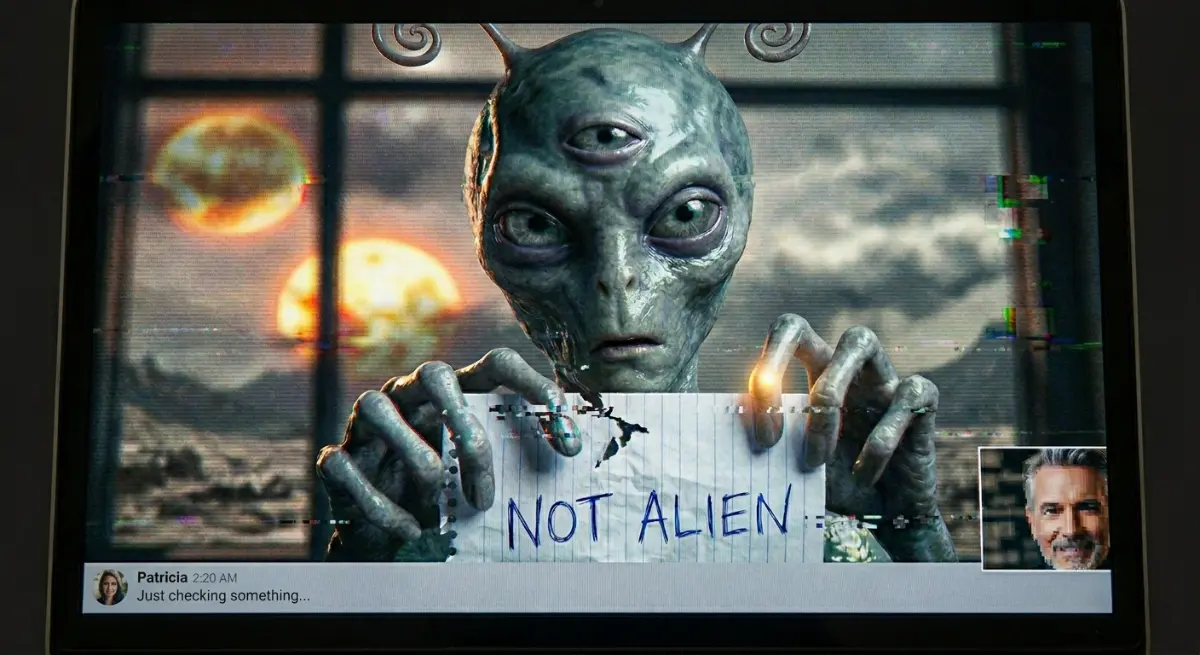
Patricia: ET did try a video call once! It only lasted four seconds because of "atmospheric interference." His face looked normal at first, but then something happened, like a glitch, you know, and for a brief moment he appeared to have three eyes, two antennae, and a head shape I don't know how to describe. Like a football? But all, like, grey and slimy? I assumed it was a Snapchat filter, because he likes to laugh. He’s funny, my ET, a real funny guy. Also, it looked like there were two suns in the window behind him. I thought it was some sort of designer lamp.
ClarityCheck: It was not a Snapchat filter, Patricia. It was not a lamp. You need to listen carefully. ET is not who he seems. ET might not even be a he at all. We appreciate your patience with the constraints of low-Earth orbit communication infrastructure. With that in mind, we have a quick test for you to run.
Ask ET to video call you while holding a handwritten note, which has today's date and a word you choose in advance. That word should be something specific, something he couldn't anticipate. A color. An animal. Maybe the words “I AM TOTALLY NOT AN ALIEN.” It has to be in real-time, live, on camera, with a note in hand.
This cannot be faked or pre-recorded. It cannot be explained away by signal issues, because if the signal is strong enough for four months of daily messages, it is strong enough for 30 seconds of video.
If Ethan declines – citing orbit, atmospheric interference, the fundamental incompatibility of his communication technology with Earth-based video platforms – you have your answer. You have, in fact, several of your answers.
The absence of video calls is central operational requirement of every romance scam, regardless of the stated reason. The person on the other end cannot appear on camera because the person on the other end is not the person in the photo. This has been true for scammers in Lagos and it is presumably true for scammers in whatever low-signal area lies beyond geostationary orbit.

Patricia: He hasn't asked for money yet. So we're fine?
ClarityCheck: Patricia. The word "yet" is doing considerable work in that sentence.
Four months of daily contact, professional-quality photos with no candid shots, no video calls, a job description that raises questions, a video call that raised significantly more questions, a shadow that is breaking the laws of physics, and seven fingers, one of which is generating its own light source.
The financial ask is typically the point toward which everything else has been building. When it arrives it will be urgent. It will have a reason that makes emotional sense, and it will be exactly as much as he thinks you'll send.
If you have not sent money, do not start. If the ask comes, block and report the profile — on the dating platform directly, at reportfraud.ftc.gov, and at ic3.gov. Your report contributes to federal tracking of fraud networks even if no money changed hands.
If you did send money at any point, contact your bank immediately — some transfers can be reversed if caught early. Then report to the dating platform, the FTC at reportfraud.ftc.gov, and the FBI at ic3.gov. Consider alerting the real person whose photos were stolen if your reverse image search identified them.
We want to be precise, because we think precision serves you better than vagueness: the photograph you enclosed shows no evidence of being a stolen image of a real human being. It shows significant evidence of being an AI-generated image of a face with no prior existence on this planet.
Whether that means ET is a scammer running a standard romance fraud operation, or whether it means something else entirely, is outside the scope of what our image lookup tool can determine.
We looked at the photo. The photo raised questions. We raised them with you.
You seem fine, Patricia.
And just for the record, yes, ET is totally an alien from outer space. Don't get on his flying saucer. If he asks for Gerald's contact information, do not provide it. We are taking this seriously now. You should contact the FBI. Also, cover your windows in tin foil. Just in case.
In the meantime, run the photo through a reverse image search. Then run every single photo he sends you after that. Stay safe, Patricia.
Can't find someone on Snapchat? Try their username, phone number, or Snapcode, then check the profile is really them.

WhatsApp has no name search. Here's how finding someone on the app works, plus how to verify a stranger's number before you meet or send money.
Learn how to find someone on dating sites by email using free methods, what they can't tell you, and how a reverse email lookup fills the gaps.